Friday, 27 March 2015

Election Eve


So, it's election eve and after all the delays, electioneering and creative campaigning, it finally looks as the elections will hold (to use one of my favourite Nigerianisms) tomorrow. The land/sea borders are closed, extra security checkpoints have been set up and a curfew will be in place from 8am tomorrow morning. No vehicles will be allowed on the roads, and shops and businesses will be closed, so the markets were busy today as residents stocked up on essentials to see them through the weekend. However, despite all this, the atmosphere - at least here in Abuja - feels calm. The six-week delay to the election has had a number of consequences - not least the fact that the ruling PDP will have undoubtedly benefitted from the postponement more than the opposition APC - but one upside is that the rather tense atmosphere foregrounding the run-up to the original election date of 14th February, when the threat of violence felt more palpable, seems to have abated somewhat. There have been lots of appeals for calm over the past few days, with politicians, civil society activists and religious leaders all encouraging citizens to exercise their democratic right in a peaceful manner. Nigerian friends I've spoken to seem to be feeling a mixture of 'let's just get this thing over with in a peaceful manner' and mild excitement at the prospect of finally being able to cast their votes.

Having said that, the number of people I know who have actually managed to navigate their way through the cumbersome process of registering to vote is very small. I met a friend for coffee yesterday who told me enthusiastically that he would be voting for Buhari. But when I asked him where he was going to cast his ballot, he replied that he wasn't actually going to vote as he had registered in another city and wasn't able to travel. Amongst my friends and acquaintances (which is, of course, a non-representative sample), this is a familiar story.

Understanding the steps that a Nigerian citizen needs to go through in order to vote explains why this might be the case. As INEC (the Independent National Electoral Commission - how independent they actually are remains a matter of debate) detail on their website with some delightful illustrations, there are three steps to casting one's vote:

1a. Register to vote (before polling day). This is itself is difficult as the registration centres (at polling units) were only open at limited times. There were many, many accounts of people - including a large number of our friends and colleagues - who queued to register on multiple occasions but didn't make it to the front of the queue before the centres closed. Our nanny tried several times to register at the local polling unit, but was unable to do so, despite having waited in line for many hours on each occasion. Part of the problem is that there have only been a limited number of days on which people can go and register - and for working people, taking too much time off work to go and queue is a problem.

1b. Pick up your PVC (permanent voter card). Sounds easy, but again this step has caused frustration. The limited hours of the polling stations has been an issue, but the chaotic nature of the registration process has also been a factor. One of my colleagues registered in Kaduna but when he went to collect his PVC, there was no sign of his name on the register. The same thing happened to friends in Lagos and in Kano, who were unable to obtain their PVCs despite having registered beforehand. All of this is designed to prevent voter fraud, but there are a significant number of people who have been disenfranchised because of the process. (To put this in context, apparently 68.8 million people of an adult population of approximately 90 million have registered to vote and 80% of those have collected their PVCs).


On election day, voters basically are expected to be at the polling units for the whole day. There are two steps to the process on election day:

2. Accreditation. Go to the polling unit between 8am and 1pm with your PVC, which you have to present to the INEC official to check your name is on the register. Once your name is found, your finger is marked with ink. You then have to wait until 1.30pm. Again, sounds easy, but the introduction of new electronic card readers (the deployment of which was one of the reasons given for the delay to the original election date), again designed to reduce voter fraud, is a massive unknown.

3. Voting. This begins at 1.30pm. Join the queue, receive your ballot paper, cast your vote.


The whole Nigerian election process has been a real eye-opener. It's not easy to organise an election amongst a population of 180 million in a developing country where the postal system doesn't function, adult literacy rates are a little over 60% and corruption is rife. Campaigning is creative: One common campaign tool involves giving out free bags of rice emblazoned with the candidate's face (the ethics of this are recognised as highly dubious but the practice continues nevertheless). Door-to-door leafleting isn't really an option in a city like Abuja, where residents live behind high security doors, so some enterprising PDP rally vehicles we were following yesterday just drove up the main highway throwing the leaflets out onto the road (where most of them remained until they were cleared up road-sweepers a few hours later).


Who knows what tomorrow will bring. Undoubtedly, the queues will be long, a number of card readers will malfunction and there will be some outbreaks of violence. But the general atmosphere does feel very optimistic and I really believe that the prospect of a relatively calm weekend is within reach. The one thing I'm sure of is that I have a weekend of single parenting ahead - Simon will be working from 7am tomorrow and on Sunday, helping to coordinate the large number of elections observers being deployed by the High Commission throughout the country (a team of well over 100). So, whilst Nigeria goes to the polls, I'll be under curfew at home playing snap, reading stories and trying to decide how many times the children should be permitted to watch 'Frozen' within a 48 hour period. And praying for a peaceful election.

Wednesday, 21 January 2015

Transport and tribal markings

Alex's reception class is currently working on a 'transport' theme and we had great fun on the way to school this morning as, taking backseat driving to an entirely new level, he pointed out all the signs he recognised: "don't go faster than 50 kilometres an hour, Mummy"; "oh, look, Mummy, a crossroads is coming up"; "be careful at the zebra crossing". (There seems, as yet, to have been no discussion in class about the mechanics of Nigerian society that means that absolutely nobody obeys any of these road signs). He also told me that 'H' meant hospital and that 'P with a line through it' meant 'No Packing'. I tried to explain that perhaps he mean 'No parking' but he was adamant that his teacher had pronounced the word 'packing' very clearly. Given that he told me yesterday that he wants to stay in Nigeria for all of Year One and probably all of Year Two, I suspect he may be sending me subliminal messages about extending the length of our posting.


We attended parents' meetings at Alex and Freya's school last week to discuss their progress with their class teachers. According the reports we'd received just before Christmas, Alex is doing generally very well, making excellent effort in class, has settled down a lot more socially and now has a good circle of friends. It seems he still needs to ensure his writing sits on a line, that there are finger spaces between the words and that there is a full stop at the end of each sentence (presumably if he achieves that goal, he will be severely overly-equipped for a world dominated by Twitter, but I still find it a laudable aim). He can find the missing numbers in a set and has learnt to complete a simple computer program by using the mouse. Good work Alex.

Freya's report made for rather more interesting reading. There is, after all, only a certain amount one can say about a child who has just turned 3. Hence: "Freya works confidently. She is okay with the concept of number 1" and "She is beginning to hold a book the correct way up." Progress indeed. What was rather more amusing were the statements just begging for further interpretation: "Freya now needs to remember to pack up after eating her snacks"; "When asked she is able to express herself and will continue as long as she is allowed" - and the giveaway "Freya is a very independent girl and loves doing things for herself" (which I interpreted to mean "Freya can be extremely stubborn at times and will happily hold out for an hour rather than capitulate in a battle of wills").

Nevertheless, it was quite a relief to know that both children are settled and happy at school and doing ok. The education-related concerns faced by many of our diplomatic friends with older children seem a long way off for us right now; I imagine worries about schools closing for extended periods because of Ebola or the forthcoming elections are considerably heightened if one's child is about to take GCSEs or A-levels, whereas my most important school-related anxieties at present revolve around trying to remember whether it is Alex or Freya that has PE on Monday. 

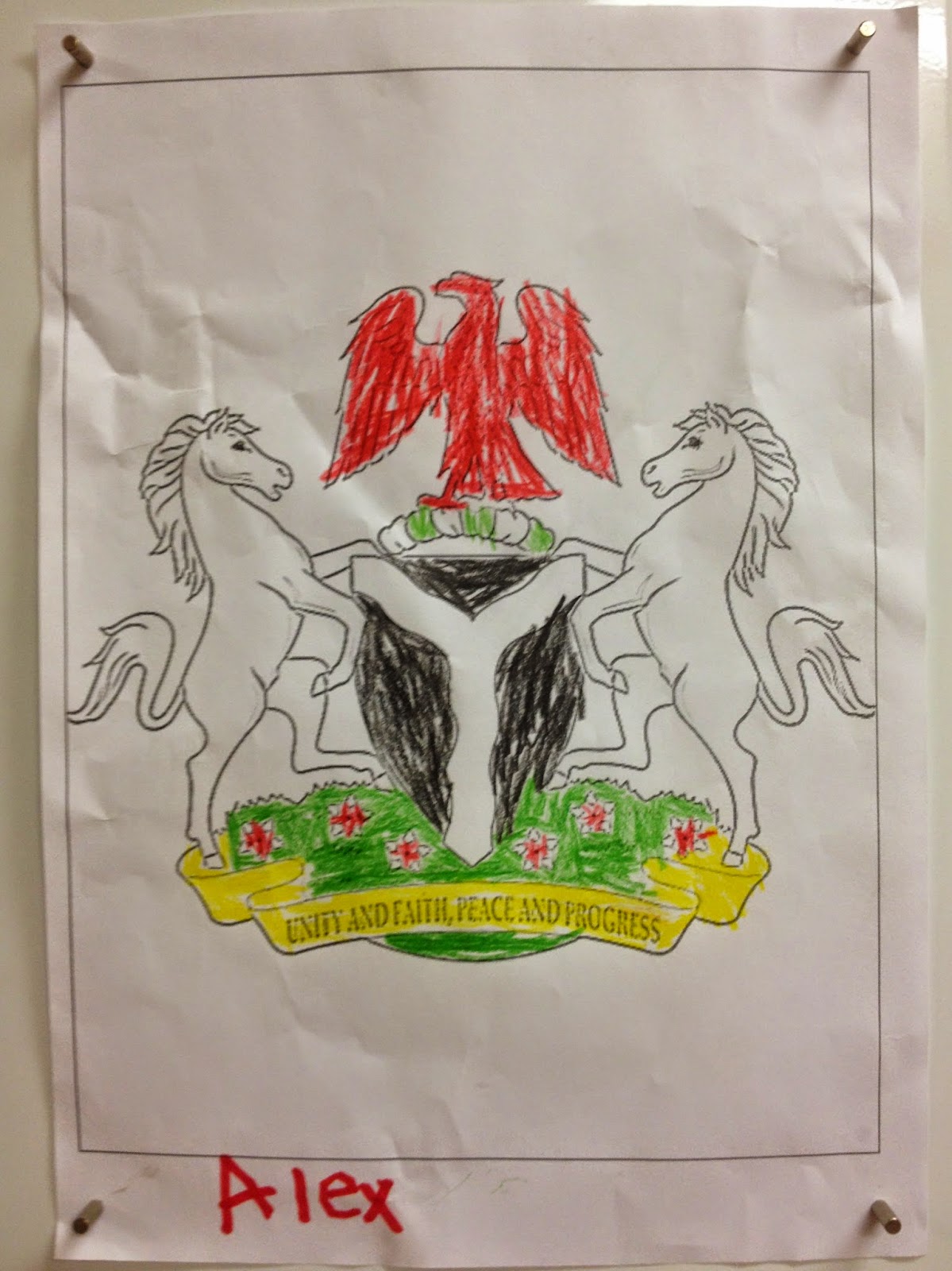
Although continuity of education can be an issue as we traipse around the world dragging our offspring with us, one of the joys of diplomatic life is the chance it affords children to grow up in different countries and experience cultures other than their own in a substantive way. This half-term, the school is offering an extra-curricular 'Nigerian Studies Programme' twice a week. (This is the same programme in which Alex learnt how to prostrate himself before me last year). On Monday, the first session comprised 'Tales by Moonlight', a gentle exploration of Nigerian folk tales, plus some artwork (a beautifully coloured-in Nigerian Coat of Arms now adorns our fridge, splendidly juxtaposed between a headless Jess-the-cat, a fish magnet from the Maldives and the portrait of Queen Amina). I had forgotten the planned theme for today's Nigerian Studies session until, as I arrived at the school, I noticed that most of the children leaving the premises had their faced painted with black lines. As soon as I entered his classroom, Alex grabbed my hand and asked me quietly, "Mummy, what are tribal markings?". The teaching assistant explained that today's theme had been 'Languages and Tribal Marks' and was an introduction to some of the traditions practised in different areas of Nigeria. Apparently Alex had been upset that by seeing some photos of young children having their faces marked and so refused to have his face painted with eye-pencilled tribal lines. He told the (Nigerian) teacher that we don't have tribal marks in England. (As she wisely commented, British people do have tribal marks - they are called tattoos).


We talked through the fact that tribal markings can help to tell people where you are from (I studiously avoided any mention of the debate about whether this tradition should be legally discontinued) and
reminded Alex that some of our friends in Tanzania also had tribal markings (the Wahehe have distinct scars next to their eyes in the shape of the pointed oval shields they traditionally used in battle) which pacified him somewhat. Once I had promised him that I would never let anyone scar his face, he perked up considerably and ran off to find out what Freya had learnt in her Nigerian class in playgroup, which turned out to be 'Moulding and Making'. What she has actually moulded and made remains a little unclear to me, but I am sure that she had a wonderful time doing it in her own independent way.

Sunday, 11 January 2015

Sunday afternoon in Abuja

We've had a wonderfully relaxing weekend - I can't remember the last time we had a Saturday/Sunday without a single commitment and it has been great to have had some time to re-charge the batteries. Last week was pretty full-on for me work-wise, although very rewarding; we ran a training workshop at the British Council for the research assistants on the gender/teacher education project I'm involved with. It has been 8 months since the 13 members of the research team all met in person, during which time the researchers have completed the first phase of the project despite incredibly challenging circumstances, including a suicide bombing on one of the College of Education campuses in Kano at which we were collecting data. Researcher safety continues to be an ongoing concern, but it was fantastic to be back together to reflect on the past few months and begin planning the next phase of the research.

Although my hacking cough has abated slightly, I'm still rather under the weather, which I used as an excuse to spend Saturday morning reading in bed - I'm taking NY resolution no. 3 extremely seriously - whilst Simon looked after the children. (I'm pretty sure that the severe eye-strain they will have incurred by watching 101 Dalmations three times before noon will be only temporary). There has also been significant progress on resolution no. 4 as I threw out 19 back issues of The Economist this morning. It felt very painful to do so - and not only because there are no recycling facilities here. I have had to reconcile myself to the fact that I may now never know precisely why China's suicide rate is plummeting, how Big Data could help stop Ebola or how the West lost Ukraine, or indeed be able to talk knowledgebly about the economics of airline seats, the Japanese luxury car-market or why the future of music is Swedish. But the spring cleaning is doing wonders for my morale and I'm feeling more on top of things than I have for months. I also caught up on three Omnibus editions of The Archers (still trying to fathom out why the producers are insisting in replacing almost every character by people who sound just like the previous actors but a bit posher (Tom, Kate, Pip) - although I must admit the less whiny Pip is a blessing) and Simon and I have resumed our Borgen-watching marathon.

This afternoon, we popped down to Millennium Park for a Sunday afternoon stroll. We'd not been to the park before as Sunday afternoons are often the time we take the children swimming at the Club, but this time of year is unusual in that it is cool enough to actually go for a walk without melting - and swimming is not a great option as the pool is coated in dust (as are our garden, the entire house, including inside the kitchen cupboards and the wardrobes, the car and my lungs). The Abuja tourist website states that 'a typical visit to the park at the weekend, most especially on Sunday, is thrilling'. Even by Abuja standards, it would be a bit of a stretch to describe our visit as 'thrilling', but it was indeed a lovely way to spend an hour or so. The park, inaugurated in 2004, is beautifully well-kept,  and was full of families, dressed in their Sunday best, out for a stroll. Everyone we passed greeted us - paying special attention to the children ("Hello boy!' "Hello girl!", "You are welcome"). We only got asked to pose for one 'snap' (Simon was quite happy to do so), and the only minor encumbrance encountered was from the cheeky 8 year old boy who had been playing football with Alex who asked me to dash him 50 naira. Which of course I didn't. Although a variety of traders sold refreshments and snacks (including the ubiquitous suya) outside the park gates, there were very few hawkers inside the park itself, which made for a much more relaxing experience than I'd anticipated. A church family party was taking place in the park (with a full-sized teddy bear mascot organising proceedings), families sat picnicking on raffia mats, children played on the swings and climbing frames, others waited to have their faces painted, an amorous couple canoodled under one of the the hedges - in short, this was 'normal' life in Abuja.


It was rather strange to have had such a tranquil day, given the carnage that is taking place elsewhere in the country. The only reminder of the bloodshed and unrest in the north-east was the solitary 'Bring Back Our Girls' banner hanging opposite the entrance to Millennium Park, the back-drop to a couple of rows of empty plastic white chairs, presumably there to accommodate the handful of committed individuals who still rally every day near the Unity Fountain in support of the Chibok girls and their families.

I was musing yesterday afternoon how calm life feels in Abuja at present, which is somewhat contrary to expectation given that the election is only 5 weeks away. But then I opened our copy of the Saturday paper to be confronted with the following headlines: 'How Jalingo grandma was killed, mutilated' (hacked to death while working on her sorghum farm, her eyes gouged out); 'Dad allows man who raped daughter to wed her (the father of a 13-year-old girl gang-raped by four youths in Kano state apparently deciding the solution to the problem is to marry her off to one of her attackers, having 'advised him to become a more responsible person'); Shocking Tales of Baga Survivors, describing how women from Baga trekked over 150km to safety following the raid by Boko Haram insurgents that massacred an estimated 2000 people from the town. The Guardian reported that the District head, Baba Abba Hassan, said most victims in the Baga attack were children, women or elderly people who were not able to escape when insurgents forced their way into the town by firing rocket-propelled grenades and assault rifles. And this on the same day we hear news of a 10 year old girl acting as a suicide bomber, killing 19 people in the market in Maiduguri - the same market which was targeted twice by female bombers late last year. This will only increase the speculation that young women and girls are being recruited to become 'human bombs' by Boko Haram terrorists, the reason being that they are less likely to be searched than men. The gendered nature of so much of the violence taking place in Nigeria is striking - and not only that instigated by Boko Haram. Meanwhile, hundreds of young men have faced (and continue to face) court-martial, accused of negligence of military duty and cowardice for refusing to fight militants in the north-east, faced with a lack of weapons, leadership and morale. Despite the enormous budget allocated to the Nigerian army, army recruits report that salary payments are not made for months and equipment is severely deficient. 54 soldiers accused of mutiny were sentenced to death by firing squad on December 17th, and the Premium Times reported at the end of December that a further 118 are set to face court-martial charges shortly. Rather a depressing situation, all in all. Trying desperately how to end this post on a more positive note, but that feels pretty difficult given the scale of the challenges facing Nigeria at present. So instead I'm going to simply give thanks for the peaceful weekend we've had here in Abuja, and sign off to go and watch another episode of Borgen...

Wednesday, 7 January 2015

The politics of pets

So the don't-mention-the-tortoise-has-died experiment didn't last too long. Alex came trotting merrily into the kitchen this morning and greeted me with the words: "Mummy, I really like Delilah. But I haven't seen her since we came home". I gently broke the news of her unfortunate demise, which he took rather well, all things considered, just confirming "So we haven't got a pet now?" and "So we won't see her again, not even in England?" before running off to the playroom, where I overheard him talking to his sister in hushed tones. "Freya, I'm afraid I've got some sad news. Delilah has died. Shall we ask Mummy for a rabbit?"

Tuesday, 6 January 2015

Harmattan Haze

Ok, so back in Abuja now and new year’s resolutions not going too well so far; I stayed up far too late last night (whoever invented FB Messenger needs a serious talking to). So I’m trying atone for that with  a focus on the resolution involving frequent and short blog postings...

For once, I have a tiny bit of spare time on my hands today as the guest we were expecting to arrive from the UK at 6am this morning failed to appear as planned. It transpired that the overnight BA flight she was on had been diverted to GHANA because the harmattan dust currently engulfing Abuja meant that the visibility around the airport was too limited for the plane to land safely. She is now in Lagos (seemingly along with half of the High Commission, who were also on the flight) and the hope is that the haze will have cleared enough by tomorrow morning for the plane to fly on to Abuja. The harmattan is particularly severe at the moment, bringing with it a fairly substantial drop in temperature (a chilly 18'C this morning, which had Abuja residents reaching for their thermals and hot water bottles) and the whole city is coated with a fine, reddish film of dust. It's hard to see further than a few hundred metres, which gives the place a slightly crepuscular sci-fi feel. This photo taken from the roof of our office this afternoon; the sky is normally a cornflower blue at that time of day:


One other piece of very sad news: Delilah, our tortoise, has died. The guards told us when we arrived home on Sunday that she took a turn for the worse after we left on holiday, just after the fumigators had been to spray the garden. Poor thing - what an awful way to go. I feel terrible about it, particularly as I've asked the evil fumigators on several occasions whether there was any risk to her and I usually move her right to the middle of the garden when they come to call, but wasn't home to do so on that occasion. We haven't told the children yet. I'm slightly tempted to just not mention it and see how long it takes them to notice. And, if I'm honest, I'm feeling slightly aggrieved because the whole point of having a tortoise for a pet is that tortoises are supposed to live forever. Or at least until the children have grown up. I mean, I imagine with a gerbil or a goldfish you pretty much start practising the pet-has-gone-to-heaven story the moment you bring it home, but with a tortoise we thought we were pretty safe on that front. Poor, poor Delilah. RIP.


Saturday, 3 January 2015

From a transit hotel in Addis...

I write from the luxurious surroundings of the 'Top Ten Hotel' in Addis Ababa, where we are in transit en route back to Abuja after two wonderful weeks in Tanzania. The hotel's website proudly informs guests that 'The Hotel will be one of international standard in the 4 star range and offer products and services comparable to that found in many oversees international Hotel', including a 'fast check-in and check-out time on which our guests will only take them 2-4 Minutes of their time'. We have not been disappointed. If only we had hot water, our happiness would be complete.

We spent Christmas with my mother and step-father in Mufindi, our favourite spot in Africa. The highlight of Christmas Day was – for the children, the fact that Father Christmas had managed to locate their whereabouts in another country – and for us, a nativity play staged at the Igoda children’s village. An adolescent Joseph and Mary had a full-on Kiswahili shouting match when he discovered she was pregnant, a live baby was produced from a cardboard box in the stable, the shepherds had a tough job rounding up flocks of human sheep, the three Wise Men rode human camels, and the hoards of visitors calling to pay homage to baby Jesus under the Christmas tree in the corner of the schoolroom caused the entire tree to topple over, narrowly missing the Angel Gabriel.


We spent New Year at the Ruaha River Lodge – our first visit since 2008 - where we met up with some friends from Abuja, went on several memorable game drives, spotted some lions, spent far longer than necessary watching the ball-rolling antics of dung beetles and passed the odd tranquil hour sitting outside our banda watching hippos play in the river.


Despite a beautiful holiday, all four of us are now rather ill - I have a streaming cold, Simon has flu-like symptoms (and told me today he’s been having pains in his kidneys for the past four days; a minor detail he apparently didn’t think worth mentioning before), the children are both snivelling and knackered. I also seem to have sprained my ankle in my sleep last night, which is quite an impressive achievement given that it was fine when I went to bed.

Notwithstanding our various ailments, we had a good flight here from Dar although, writing those words, I realise that the bar for what constitutes a ‘good flight’ has descended somewhat in recent years. It used to mean Simon and I getting through multiple gin and tonics, a couple of decent movies and polishing off at least one novel each. These days it means arriving at our destination with both children intact, not leaving anything of major importance on the aeroplane and making it through arrivals without losing Alex, Freya or our tempers. Rather frustratingly, Freya has recently taken to equating arriving at airports with a seemingly irresistible need to slide along the floor on her knees. (Alex actively encourages this irritating behaviour: When we last passed through Addis airport, we came out of baggage reclaim with Alex and Freya very sweetly holding hands and trundling along behind us. The next thing I heard were screeches of laughter from the assembled Ethiopian meters-and-greeters as Freya dived on to the floor and Alex, still holding her hand, dragged her slithering along on her tummy for a good ten metres).

I must admit I quite enjoy these transit stops in Addis – this is our fourth – as it does give one time to adjust from holiday mode back to gritty reality. And reality will begin with a bump tomorrow as I log on to the internet for the first time in two weeks, gear up for a British Council training workshop we’re running next week and try and catch up with all the publishing-related correspondence. This little breather has also allowed me the time to make some belated New Year’s resolutions, which I hereby declare: 1) Try to be more patient with the children (and Simon), especially when I’m tired; 2) Go to bed earlier; 3) Read a book a week; 4) Admit I’m never, ever going to have time to read the whole of The Economist every week and stop hoarding the back issues next to my bed; 5) Blog more frequently, even if the posts are short ones. Hhhm. I rate my chances with 3) and possibly 5). 1) will be almost entirely dependent on 2); 4) is never going to happen. Let's see how this goes, 2015...

Tuesday, 26 August 2014

Ebola update...and illegal chickens


This is one crazy country. I checked the online news before going out this evening and was delighted to read that 'Nigeria announces containment of Ebola, 2 more discharged, last patient stable'. Then when I was out at supper, my friend received a phone call to say that the government had just announced on TV that all primary and secondary schools in Nigeria are to remain closed until October 13th. October 13th! That's almost 7 weeks away! Alex is already climbing the walls after being back in Abuja for a week and I am desperate for school to start - the new academic year is due to commence next Monday. (And before I say any more, I recognise the contradictory nature of my position as before the summer break I was literally counting the hours until the end of term when I could take Alex out of school and stop worrying about the possibility of getting caught up in a Boko Haram attack. And now I am aghast that schools are not being allowed to open. Just shows what this place does to you).

What has incensed me is the utterly irrational behaviour of the government. On the same day that the Minister of Health annnounces that Ebola is basically under control, the Minister of Education declares that all schools will remain closed until 13th October. And this is all schools. Not just schools in Lagos, the only city in which there have been cases of the virus, but all schools in Nigeria. It is totally bonkers. The official statement said that the reason for the closure was 'to ensure the safety and well-being of all students in our schools throughout the Federation' and to allow time for two teachers in every public and private school in the country to be 'trained by appropriate health workers on how to handle any suspected case of Ebola and embark on immediate sensitization of all Teaching and non-Teaching Staff in all schools on preventive measures'.

So, having decided that the Nigerian government was actually handling this whole Ebola outbreak quite sensitively and sensibly, I have now revised my opinion somewhat. One sure way to create panic within a population is to close all the schools. And the edict makes no sense. Ebola is very hard to catch - you have to have contact with bodily fluids of an infected person and an Ebola sufferer is actually only contagious when they develop the symptoms (which are hardly difficult to spot, even by untrained staff; I imagine a child suffering from severe fever, intense weakness, vomiting, diarrhoea and bleeding from the eyes might catch the attention of even the most unobservant teacher). The incubation period is from 2 to 21 days, but people are not contagious during this time. There is absolutely no reason why schools need to close. Imagine the inconvenience for millions of parents. And if schools, then why not universities, or cinemas or hospitals? I honestly don't know why I'm surprised; given that the federal government's security strategy for the World Economic Forum in May involved ordering a complete shutdown of Abuja for three days, this news should hardly come as a shock. And taken in the context of a dysfunctional education system where universities, polytechnics and Colleges of Educations regularly shut down for months on end due to strike action, a mere delay of 7 weeks to the start of term is small beer. (The Colleges of Education returned to class in late July after a 7 month strike; the polytechnics returned on 14 July having been on strike - for 10 months - since October 3rd. And this was hot on the heels of a dispute at the public universities, where staff were on strike for 6 months during the second half of 2013). So despite the frustrations of the school closure, we should spare a thought for a Nigerian student trying to pursue a tertiary education course here (not to mention a harassed mother of two small children trying to work on a research project within the Nigerian higher education sector).

But this is Nigeria and I have realised that the way to cope with life here is not to take anything too seriously. This is actually relatively easy to do when the headline of the second most important item of news on the Nigerian agenda tonight reads: Deputy Governor Of Enugu State Impeached For Running A Poultry At The Government House.

Wednesday, 20 August 2014

Salt Water and Sheep Dip

I was supposed to be giving a presentation at a conference in Lagos today but instead spent the morning at a 'Coffee morning & Ebola Briefing' (now there's a sentence I didn't imagine I'd ever be writing) here in Abuja. Such are the vagaries of diplomatic life. Or at least diplomatic life here in Nigeria - I don't remember attending too many briefings about fatal diseases during our posting in Washington DC. It probably says something about my relaxed, post-holiday state of mind that the words 'coffee morning' grabbed my attention more than 'Ebola briefing' but I was really excited to have the chance to catch up with friends after a summer away - there's a great community at the High Commission here and it was fun to see everyone again.

Despite the continuing terrorist attacks in the north of Nigeria whilst we were away (including a suicide bombing at Kano state polytechnic, one of the institutions at which our research assistants are collecting data for the British Council research project I’m working on), Abuja itself feels relatively relaxed at present - I think partly because the media is currently more focused on the threat from Ebola than terrorism. (When we were transiting through Addis last week and were asked where we were travelling to, we received several ‘Good Luck with Ebola’ wishes, which made a pleasant change from the previous default response of ‘Take care with Boko Haram’). There have been five deaths so far from Ebola in Nigeria, all in Lagos and involving people who had direct contact with Patrick Sawyer, the Liberian-American who brought the disease to Nigeria. Contrary to expectation, the Nigeria government has been pretty responsive to the threat and appears to be taking significant measures to ensure that the virus is contained. When we arrived at Abuja airport yesterday we were asked to stand in a line whilst a security guard wearing a face mask and gloves pointed a gun at our temples and fired a red laser at us. I think he was trying to take our temperatures. 


The biggest problem the authorities face is lack of education. When the first cases of Ebola were reported in Lagos, millions of text messages were sent out instructing Nigerians to bathe in and drink large quantities of salt water, preferably before a 4am deadline, in line with nonsensical advice issued by the Attah of Igala. Several people died as a result of consuming too much saline liquid

We are lucky in that we have access to a good health clinic and an inbox full of advice about avoiding the disease. The risk of catching Ebola is miniscule, but it doesn't stop friends worrying about us. We have just been back to the UK for my god-daughter's wedding in Suffolk. Having clearly received a text directly from the Attah of Igala, the friends we were staying with offered to install a sheep dip at the end of their drive for us to pass through before entering their house...

Wednesday, 13 August 2014

Tanzanian Tales


We’re back home tonight after a wonderful three weeks away in Tanzania. This was the first time we had taken the children to East Africa and it was absolutely fantastic to introduce them to our favourite country. We spent most of our time visiting friends down in Mufindi and Iringa, before finishing up with a few days relaxing on the beach near Bagamoyo. 

We stayed with our friend Sion in Dar for a couple of days at the start of the trip and had great fun catching up on several years' worth of news whilst the children made themselves at home in the playroom. Some aspects of the city have changed significantly since I was last in Dar 5 years ago. The traffic was much worse (it took us a full two hours to crawl from the airport to the Peninsular), the supermarkets are swankier and the High Commissioner's Residence (my future home - I am seriously thinking of applying for the job of High Commissioner's wife regardless of whether Simon ever bids for the role of High Commissioner) has been painted a very odd shade of mustard yellow.

We travelled down to Mufindi via Mikumi national park, where we stayed overnight at Stanley’s Kopje, with its stunning views and canvas cabins. After the drive down from Dar, the children were a little tired as we entered the park. Freya slept throughout the 2 hours that it took us to reach our camp, missing a close encounter with 4 staring buffalo (I was too scared to take a photo) and a glimpse of a family of elephants which even prompted Alex to look up from his colouring for a second and breathe a quiet ‘wow’. I’m not sure that Freya completely understood the concept of a visiting national park in Tanzania. When we asked her on the guided game drive which animal she’d most like to spot, her reply was instantaneous: ‘a sheep’. 


Fortunately for Freya, we headed off to Mufindi the next day to visit friends at the wonderful Highland Lodge, where there were plenty of farmyard animals of all descriptions to engage with. Her wish was granted and she fed a lamb – and a rather greedy calf - from a bottle. Mufindi is rapidly becoming our second home – it is stunningly beautiful and very close to our hearts. This is where we have planted a small plantation of pine trees - the objective being to harvest them in 10 years' time and start building the dream home (well, Simon's dream home - my heart is still set on the High Commissioner's Residence in Dar). Mufindi is also the location of the Igoda Children's Village project with which Simon has been closely involved with for almost a decade, and it was great to have the chance to catch up with developments in person. The community has been ravaged by AIDS but the charity is making a huge difference - from being on its knees ten years ago the community is now much more robust and able to support itself. We took the children to visit the nursery school affiliated to the project, I toured the sewing school and Simon visited the hospital at Mdabulo, which has been transformed since our last visit. Our friends Geoff and Jenny have been running the project for the past six years and now have two children of their own (the fabulously named Twilu and Tuke, two auburn-haired dynamos whom Alex kept referring to as 'the orphans' until I explained to him that Geoff and Jenny were actually their Mum and Dad).


We were incredibly well looked after by the entire Fox family and the children managed to fit in several firsts during their stay in Mufindi: first time sleeping in bunk beds; first time on a horse – Freya looking particularly impressive on her mighty steed, she has fabulous posture and no fear at all; first time on a quad bike; first attempt at fly-fishing and first time making a bow & arrow. I took the children to the trout hatchery to watch a rather messy process that I'd rather not describe (suffice to say that I now feel slightly queasy whenever Freya, who still has difficulty pronouncing her ‘k’s, asks for ‘milt’ to drink).


Upon leaving Mufindi, we made the journey – three hours by road – to Banawanu, a tiny village near Iringa, where our dear friend Christina was awaiting us. This was a poignant visit. We named our son Alex after our Tanzanian friend Alex Kibiki, one of the kindest, gentlest and special people one could ever hope to meet. Incredibly sadly, Alex was killed in a road accident three years ago - knocked off his piki-piki (little motorbike) by a lorry as he rode into work in Iringa - and he and our little Alex were never able to meet. Alex’s death still feels very raw and I had been trying hard not to think too much about the moment when we would arrive in Banawanu and he wouldn't be there to welcome us. He is buried, alongside other members of the community, in a little shamba just behind the house, surrounded by maize and shaded by avocado and papaya trees. We visited the grave, and Christina spoke to him and told him we had come to visit, and I just about held it together until we were walking back to the house. Simon came for the wake but this was the first time that I had visited since Alex died. I still feel profoundly affected by Alex’s death, I think partly because he represented to me all that is good about Tanzania - he was honest, hard-working, caring, inquisitive, enormous fun and had the potential to make a real difference to his community - and his death feels like such a waste. He had put himself through four years of agricultural and veterinary training in Arusha, spending months apart from Christina and their three daughters in order to complete his education. On my last visit, he had just established a local veterinary practice in Iringa and we accompanied him on his rounds as he inspected a cow in difficulties and castrated a dog (without anaesthetic – Simon’s eyes still water every time he thinks about it). Alex's death also represents the fragility of life here, and this was brought home to me yet again on this visit with the news that Alex and Christina's daughter, Rose, who is currently at secondary school up in Mwanza, had just been diagnosed with typhoid. She was receiving treatment and was doing ok, but is still very weak. 


Despite the sad circumstances, we had a wonderful time during the three days we spent with Christina. The children were able to sample ugali, mandazi, rice and beans, and fish cooked on a charcoal fire. They absolutely loved bathing from a bucket of hot water - I've never heard Freya giggle so much - and had great fun pretending to serve customers in Christina's little duka, whilst Simon sat outside on the little verandah drinking Safari beer and practising his Kihehe with the locals. We visited one of Christina's neighbours who had offered to give us some milk for Freya's breakfast - and Alex helped to milk the rather surprised cow! We called in at the house in Tosamaganga in which Simon and his friend Jonathan (now Freya's godfather) lived when they were both VSO volunteers. Iringa was much the same, with the exception of a swish new cafĂ© and bookshop aimed at ex-pats. There were even a couple of mamas in the market who still remembered Simon and Jonathan, which I think was just about the high point of Simon's trip. 


We spent another night in Mikumi on the way back to Dar – this time in Vuma Hills, another of the Fox’s stunning camps. We had a fabulous game drive in the evening, where we spotted lions, crocs and hippos as well as the 'usual' animals. The game drives were notable for the questions they prompted from the children, who were a lot more engaged with the whole experience on the second Mikumi visit. 'Can a hyena run as fast as a lion?', asked Alex. 'Do giraffes sleep standing up? Can warthogs swim?' Not to be outdone, Freya joined in with her own questions: ‘Can a hyena eat a house?’ ‘Can a hyena fly a plane’? ‘Have you ever seen a hyena eat a malaria tablet?’ ‘Do sharks eat carrots?’ ‘Can a lion eat you if you’re sitting on its back?’

We spent our last three nights on the beach at Lazy Lagoon – a wonderful place to finish off the trip, where we did nothing much but play with the children, swim, tuck into delicious meals and read a couple of novels. All was well in paradise until the last evening when Freya jumped on the bed and split her head open on the bed post. Some homemade butterfly stitches seem to have done the trick – let's just hope the wound has healed well enough to take them off by the time she is a bridesmaid next Saturday...


This really was the most fantastic family holiday - it truly felt as if we were making memories. I'm not sure how much the children will remember of their first trip to Tanzania, so asked each of them (and Simon) to tell me what they enjoyed most about the entire experience. And here's what they said:

Highlight of Simon’s holiday: Alex marching up to the Masai guard at Vuma Hills and asking to see his knife; Alex finding a homemade football (made of plastic bags and elastic bands) and wanting to bring it home.

Highlights of Alex’s holiday: Meeting Christina and seeing Alex’s grave. (I totally welled up when he gave that answer).

Highlights of Freya’s holiday: Playing with in the playroom at Sion’s house; sleeping in the little bed at Sion’s house; playing with the pussy cat at Sion’s house (I honestly don’t know why we bothered to take her along).

As for me:

Highlights of my holiday: Playing ‘Happy Families’ in a hammock on Lazy Lagoon; seeing lions on the game drive, drinking tea on the verandah at the Southern Highlands Lodge.